
'This is not just about Modi saying it, every Indian should say this -- if we want India to become the third-largest economy, every political party and every leader, keeping aside their hesitations, must work in the nation's interest and awaken the spirit of Swadeshi among the people'

Maharashtra has topped the list of states with the most favourable ecosystem for the growth of Farmer Producer Organisations (FPOs), replacing Madhya Pradesh, which has slipped to second place, according to the latest Ease of Doing Business for FPOs (EoDBF) ranking.

'What the US appears to be doing is to force India to be "the buyer of last resort", on whom their products can be dumped, 1.4 billion people have to eat something, so why not eat American corn?' 'What is exercising the Trump lot is the fact that most of the farms are in solidly Republican Midwestern states: Illinois, Indiana, Kansas, Michigan, Minnesota, Missouri, Nebraska, North Dakota, Ohio, South Dakota, Wisconsin,' points out Rajeev Srinivasan.
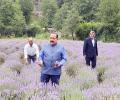
From using lavender in traditional Dogri embroidery to making essential oils, beauty products and food syrups infused with this flowering plant, Bhaderwah, once known for its maize fields, is embracing lavender to bring about an economic transformation to their small town.
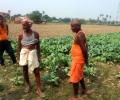
'The government's priority is not farmers.'

Four big global companies - Bayer, GenZero (a wholly-owned arm of financial major Temasek), Shell and Mitsubishi - have decided to scale up their carbon credit programme in nine states to empower farmers. The credits are generated through the adoption of smart agriculture practices - Alternate Wetting and Drying (AWD) and Direct Seeded Rice (DSR). Since over a year, the project, which was being run on a pilot basis, has positively impacted 10,000 farmers, covering more than 25,000 hectares.
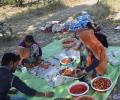
'To bring about a paradigm shift in farmers's income, we need to change our approach to agriculture, and transit from the narrow prism of cultivation to a full-fledged enterprise, by building all associated supply chain linkages.' 'This alone will make the farmer an entrepreneur in his own right.'

New lower GST rates kicked in from Monday, resulting in a slashing of prices of as many as 375 items ranging from toothpaste and shampoo to cars and television sets, a move seen as an attempt to boost consumption to cushion an economy facing tariff headwinds. Tax rates of 5, 12, 18, and 28 per cent have been clubbed into two rates of 5 per cent and 18 per cent, resulting in a reduced price of 99 per cent of daily use items.

Amid the impending rejig in the goods and services tax (GST) rates, an association representing the country's beverages industry has appealed to the Centre to not classify aerated beverages as sin/demerit good and bring it under the 18 per cent slab while citing their "mass consumption" as a reason.
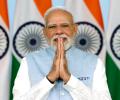
The Congress party has criticized Prime Minister Narendra Modi's handling of GST reforms, calling them inadequate and demanding an apology for the tax imposed on essential items. They argue that the reforms are merely a 'band-aid' solution and that the government should address the states' demand for extended compensation.

The life and non-life insurance industries are hopeful of a reduction in the goods and services tax (GST) on health and life insurance premiums, after Prime Minister Narendra Modi, in his speech on Friday, announced GST relaxations aimed at providing relief to ordinary citizens, farmers, the middle class, and the small and medium enterprises (MSME) sector.

While naming him as the NDA candidate for the Vice President's post, the BJP had described him as 'Kisan putra', a move seen in the political circles aimed at reaching out to the politically significant Jat community which had participated in huge numbers in the year-long farmers' protests against agriculture reform measures unveiled in June 2020.
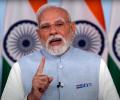
Prime Minister Modi urged the people of the country to take pride in selling and buying indigenous goods.
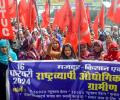
Over 25 crore workers across India are set to strike against new labour codes and privatisation, potentially disrupting banking, postal, and other essential services.

'It was like rigorously preparing for a solid, good exam...' 'I don't know what marks I will get, but I felt the rigorous preparation of an exam.' 'You may sweat, but I feel rejuvenated.'
The proposed 'Next Gen GST' with sweeping reforms, lower tax rates, and just two slabs, aims to boost the economy amid tariff threats and set the stage for a single tax rate regime by the time India becomes a developed nation, government sources said.

Kharge also targeted Prime Minister Narendra Modi, saying the people should not believe Modi's "guarantees".

The ministry stated that for vehicles designed for E10 and calibrated for E20, mileage may drop by just 1-2 per cent, while in other vehicles, it could be around 3-6 per cent.

Bollywood actor Vivek Oberoi has shared details about his journey from film stardom to becoming a successful global entrepreneur. In an article for Rolling Stone, which he also posted on social media platform X (formerly Twitter), Oberoi explained how stepping away from fame helped him focus, grow, and build a lasting legacy.

Congress leader Rahul Gandhi has written an open letter to farmers, congratulating them on their 'historic victory' after the Centre announced its decision to repeal three contentious farm laws, and assured them of his party's support in their future struggles.
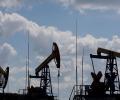
The government has no say in where the country's refiners source oil from because these are commercial transactions.

More than 25 crore workers engaged in sectors ranging from banking, insurance, postal to coal mining, highway and construction are expected to go on a nationwide general strike on Wednesday, potentially disrupting services across the country. A forum of 10 central trade unions and their associates has called for a general strike or 'Bharat Bandh' to "oppose the anti-worker, anti-farmer and anti-national pro-corporate policies of the government".

The government will formulate a strategy to make India self-reliant in edible oils by boosting domestic output of oilseeds and launch a comprehensive programme to support dairy farmers, Finance Minister Nirmala Sitharaman announced on Thursday. India imports a large quantity of edible oils to meet the domestic demand. During the 2022-23 marketing year (November-October), the country imported nearly 165 lakh tonnes of cooking oils, valuing a whopping Rs 1.38 lakh crore.

Finance Minister Nirmala Sitharaman on Thursday announced plans to increase milk and dairy production in the country. India is the largest milk producer in the world but there is low productivity, the finance minister said.

Ishwak Singh's earnestness and the rustic energy of his mates keeps Mitti engaging, even when it starts to get preachy, observes Deepa Gahlot.

The government on Friday scrapped a minimum price threshold that it had set previously for exports of onion as it looked to pass on the benefit of international glut to Indian farmers. The government had previously fixed a $550 per tonne as the minimum export price (MEP), which essentially meant farmers could not sell their produce overseas at lower than this rate.

In the past 10 years, over 500 PSB officers have died by suicide. When targets are overwhelming, senior management and customers are both impatient, and there is constant fear, not every banker has the resilience to survive and thrive, warns Tamal Bandyopadhyay.
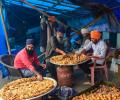
Farmers protesting at various sites on the border of Delhi on Monday unequivocally said they are only concerned about their common goal of having the three farm laws repealed, and what has been offered to the agriculture sector in the Union budget did not matter.

President Droupadi Murmu addressed the nation on the eve of Independence Day, praising the response to terrorism, highlighting achievements in defense self-reliance, and emphasizing unity and progress.

'LAP is suited for borrowers with a steady income, sound repayment discipline, and a clear repayment plan.'

Inflation raises prices for farm inputs as well as farm products, resulting in uncertain effects on the current net incomes of farmers, the National Council of Applied Economic Research (NCAER) said in its monthly report.
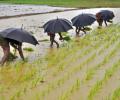
The decision to scrap the plan for landless workers and focus only on small and marginal farmers was made as there was no proper method to find out who qualify as landless labourers.
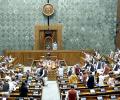
India's opposition parties have sharply criticized the Union Budget, calling it inadequate to address the country's economic woes and accusing the BJP-led government of using it to woo voters in Bihar and Delhi ahead of upcoming elections. Leaders from the Congress, TMC, DMK, SP, and CPI(M) voiced their disapproval, highlighting concerns over inflation, unemployment, and the lack of substantial measures to support the agricultural sector and the poor. They also criticized the tax cuts for the middle class as insufficient and coming too late after years of high taxes and rising prices.

Barely days after imposing a 40 per cent export tax on onions to cool down soaring prices, which, in turn, triggered widespread protests across the main growing belts, the Centre on Tuesday sought to mitigate both political and economic tensions gripping parts of Maharashtra. It decided to procure an additional 200,000 tonnes of onions at Rs 2,410 per quintal for its buffer stock from farmers, a rate that is strikingly close to the price at which they were being exported before the 40 per cent duty was levied on August 19. The export price before the imposition of the duty stood at around $320 per tonne free on board (approximately Rs 2,650 per quintal).

The government's predicament is a result of its own doing: That of not ensuring adequate buy-in by the stakeholders before passage of the laws, notes Vivek Gumaste.

India's recently-enacted agri laws have the potential to increase farmers' income, but there is a need to provide a social safety net to the vulnerable cultivators, IMF's Chief Economist Gita Gopinath has said. Indian agriculture is in need of reforms, she said. There are multiple areas where the reforms are needed, including infrastructure, the chief economist of the Washington-based global financial institution said on Tuesday. The three agri laws, enacted in September last year, have been projected by the Indian government as major reforms in the agriculture sector that will remove middlemen and allow farmers to sell their produce anywhere in the country.

President Droupadi Murmu's address to the nation on the eve of the 79th Independence Day.

Recent documents by NITI Aayog and periodic labour force surveys on employment show that the importance of agriculture is rising in the Indian economy.

Modi also appealed to farmers not to burn crop residues so as to curb pollution.

Trump's tariffs, falling shrimp prices, and fears of additional US levies, spark a crisis in Andhra Pradesh's politically vital aquaculture sector.
